


COLOR
& ART.
Color begins with light
Color emerges when light meets matter and is interpreted by the eye and brain. The visible spectrum is only a small part of electromagnetic radiation.
Choose a wavelength
Slide across the visible spectrum and examine an approximate screen representation of monochromatic light. Display colors are illustrative, not a calibrated spectrometer.
Nothing is seen in isolation
The same color can look radically different depending on its surroundings. Perception is a relationship, not a fixed value.
One color, two realities
Change the surrounding colors and compare the two identical squares. Contrast shifts perception without changing the sample.
Two systems. Opposite behavior.
Adding colored light builds toward white. Combining ideal subtractive primaries removes reflected light and builds toward black. Screen light and physical pigments are not equivalent.
Mixing light
Control the intensity of red, green and blue light. Equal full intensities produce white in the idealized RGB display model.
Mixing pigment
Control cyan, magenta and yellow absorption. This is an idealized subtractive model: actual paint depends on pigment chemistry and substrate.
Art changes the observer
Art can provoke emotion, recall memories, challenge assumptions and create new ways of seeing. Different compositions can generate very different responses.
One canvas, many emotional languages
Select an intention. Geometry, rhythm and chromatic relationships change together. These are artistic interpretations, not universal psychological diagnoses.
A room is never one color
The same wall changes through the day, with light temperature, intensity, finish and surrounding materials. Color belongs to a specific place and moment.
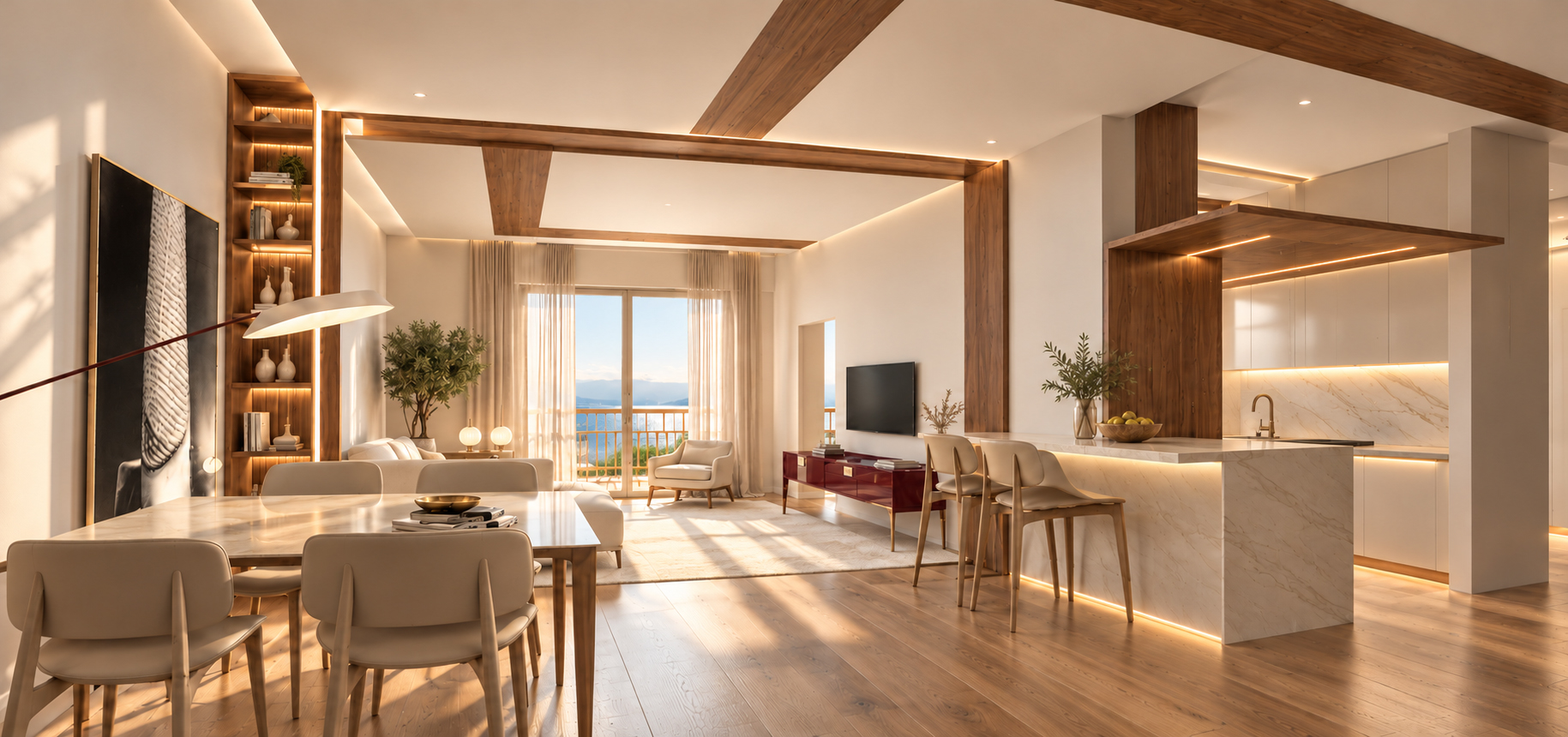
Material × light × time
Explore an illustrative architectural scene and compare finishes under warmer or cooler light. The simulation is conceptual, not a photometric prediction.
From philosophy to decisions
For RKtetto, color, material, lighting and art must be specified as an integrated system — researched, tested and evaluated in the actual project.
Build a project direction
Explore a preliminary design strategy based on typology, emotional intention, daylight and material. This creates a study brief, not final specifications.
Project parameters
Suggested material and color direction
COLOR STRATEGY
LIGHTING STRATEGY
MATERIAL STRATEGY
ART STRATEGY
The complete Color & Art Manifesto
A position on seeing, feeling, creating and living — and the principles by which RKtetto approaches the built environment.
Art is not decoration.
Color is not a finishing touch.
Architecture is an experience.
RKtetto believes that color is a language, light its origin, matter its medium and perception its interpreter. Art is a way of thinking, feeling, questioning and discovering.
RKtetto embraces science without sacrificing imagination, respects history without being confined by tradition, and pursues beauty without reducing design to appearance.
The most meaningful creations change what people notice, what they feel, how they think and how they live.
ART CHANGES HOW PEOPLE SEE.
TOGETHER, THEY CHANGE HOW PEOPLE EXPERIENCE THE WORLD.